Should anyone ask, how to consume podcasts

Podcasts are my longform media. I consume lots of podcasts. They are my anti-television and an echo to the radio that would play back thoughtful BBC World service broadcasts from my father’s workshop in information-dark South Africa in the late 80s. Podcasts are the roughage in the titbit driven information diet. 

Enough with the analogies, you are here to know what and how. 

How to listen

Download Pocket Casts (iOS / Android). It’s about the price of a coffee. And when you consider that you get free upgrades year after year, great value. You could try all the others. The Doggcatcher, the built in Apple podcast (worst of them all) and BeyondPod. I’ve worked my way through them all and arrived at Pocket Casts.

Pocket Casts ensures you always have a supply of the podcasts you follow on your device. Freshly plucked from a WiFi access point near you so you aren’t using up valuable mobile data. Pocket Casts presents the podcasts beautifully, with nice show notes on an intuitive interface.

Other features I like:

  • The ability to play some podcasts faster (for example BBC podcasts can comfortably be played back at about 1.5x speed, and I’d play back a German podcast slightly slower.) Pocket Casts will also pitch adjust so your podcaster doesn’t sound like Mickey Mouse. 
  • Pocket Casts will auto-delete podcasts you have listened to, or always keep the five latest episodes. You can star episodes you have liked and they will be saved. I use this feature for saving some DJ mixes to listen to again when running.
  • Subscription and listening position synchronisation: subscribe on your phone. Listen on your tablet. Finish off on their webpage. Everything is synchronised.

NB: This is not a paid promotion for Pocket Casts, simply me having tried all the other podcast tools and finding Pocket Casts to be significantly better. 

What to listen to

My podcasts subscriptions can be imported into Pocket Casts.

Discovering your own favourite podcasts:

Most of my podcast grazing comes from personal recommendation. Occasionally hackernews will include a “what podcasts is everyone listening to”? AskHN.

Pocket Casts also includes a helpful “ Discover” tab. This helps you search for podcasts by name without needing to know the subscription URL. However, the discover tab could benefit from a:

  • “based on your current subscriptions you might like ….” and, 
  • “podcasts similar to this podcast” feature.

Specific favourite podcasts:

  • Storytelling: The Moth, where a bunch of storytellers get on stage and recount their lives: some sad, some humerous. All touching.
  • Fun: The Prarie Home Companion/The News From Lake Wobegon. "Where all the women are strong, where all the men are good looking and all the children are above average.“
  • Economics: I’m a big fan of Econtalks and the Economist. Econtalks dives deeper into a topic, The Economist talks around the weekly articles.
  • BBC podcasts: Most BBC radio programmes are available as podcasts.

Podcasts suggestions to simon@imaginator.com are always welcomed!

Should anyone ask, being around people.

Today was a good day: I received a letter in the morning that was very touching. And then cycled north from Berlin, seventy-something kilometers to Vogelsang to look at the old Soviet machinery, buildings and climb a very tall chimney to get an amazing view over the forest.

The military history angle was interesting. 

But really it was just lovely being out of the city and having nice company.

Thanks to Mizar for arranging.

image

Should anyone ask, attachment to ideas

Ideologies suck! 

Ideologies rule!

What makes a good ideology? Is it because it’s something that I also believe in? Like open source? Or don’t kill your enemies? Or believe in $DEITY? Or staying true to an idea?

Or other beliefs: Staying with a partner in a challenging  relationship? Or working on something that isn’t working out in the hope of things turning around?

How long should we cling to an ideology before we let got and are freed to accept new beliefs? How long do we keep trying to make something work?

I’ve never been a huge fan of the MVP school of thought. My take on it is that it’s more of a “make something shitty and find a victim.” There’s no minimum viable iPhone or no minimum viable Pebble watch. Products need love and care to come to life. Throwing spaghetti against the wall will tell you if it’s cooked. It won’t tell you if it’s going to make a great meal.

So I’ve been working on different ideas pushing them along hoping that they will catch. I don’t have the answer. But I do know that ideologies can both support us (respect others), and be destructive (martyr yourself for a greater cause). 

But there’s also a time when we need to let go of some idea to make space for new ones. There’s good letting go and there’s throwing away. To me a good letting go is more a case of… “so we’ve come this far, now let’s build on what we have but in a different direction”. 

Today has been an interesting day of exploring something same-but-different. A pimp-your-ideology-into-something-better day. Time to jump back into the saddle and head off in a new direction.

image

Should anyone ask, taking breaks

I’ve usually relied on partners to prod my reticent self into taking a break with them. The freedom of working for your own company and choosing times usually results in my working until I burn-out, then taking a quick break that doesn’t really do much for recovery, and then jumping back on the horse.

2015-02-09 16.27.39//embedr.flickr.com/assets/client-code.js

I started this year in great form: a lovely trip to South Africa paddling down the Orange River through the Namibian desert with my cousin. It was a wonderful holiday. Work has been hard. Really hard. There was a work trip around Easter with a few days off, then a week’s stay-cation in Berlin. Not really a holiday. And too many other things going on to really relax. And so it is today: feeling close to being burned out and knowing that I must look after myself if I want to prevent full-burnout. It’s not a good situation to be in and I can only blame myself.

I love travelling. That feeling of taking off and leaving the day-to-day behind and the adventure of exploring a new place.

At the end of this year I’m meeting an old school friend in South Africa’s Hluleka Nature Reserve. It’s a wonderfully desolate part of the Wild Coast.

image

Until then, I need to plan a break but don’t see how to take it. And don’t see how to survive without taking it. 

Should anyone ask, today wasn’t perfect

Not a perfect run. 

Not all the way. 

Stopped some of the way. 

Walked and thought some of the way. 

One of the headphones didn’t work. 

It was perfectly imperfect. 

Yesterday I listened in on one of Wendy’s friend’s video workshops. It was about observing the ego and being aware of the need to distance ourselves from our feelings. Observing that you talk negatively to yourself as a means to improve the inner dialogue into something of a fanclub rather than the angry “you’re not perfect” coach. 

I’ve also started the Monash university mindfulness course. I really liked week 1. Less woo-woo, more science of how our brains deal with interrupts and the professional value of being in the moment. Excited to see where the next 6 weeks take us. 

And that was an almost perfectly late blog post. Goodnight.

Should anyone ask, imperfection isn’t easy

Life is really easy. Instead of nobody handing you a life-manual there are thousands being stuffed down your throat. From old-school Bible-types with rather dubious advice to newer self-help gurus and their amazon hit sellers. Then there are the manuals of manuals: I enjoyed Tom Butler Bowden’s distillation of all the great self-help books into 50 Self-Help Classics and his 50 Success Classics. The chapters were short enough to get the gist of the the book and 50 was enough to see trends popping up between all the books. It’s a good read. But ultimately I think we need to write and rewrite our own self-help books. Write oneself, because we are all different. Rewrite, because we change.

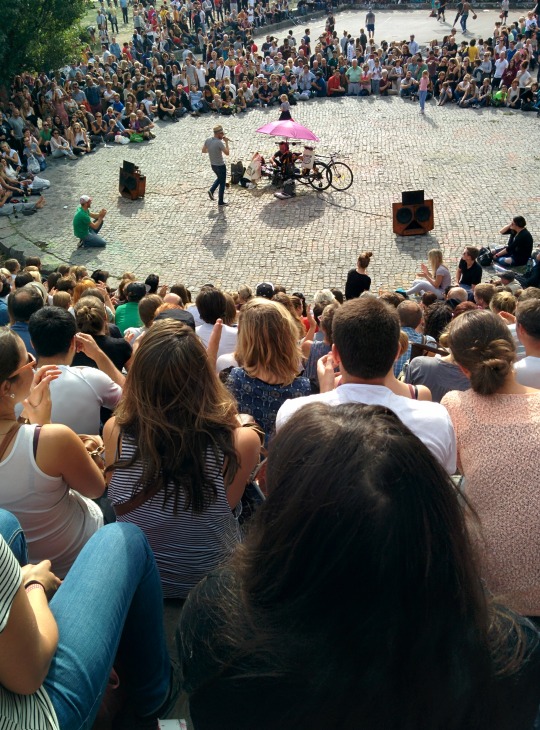
Yesterday I was at the Mauerpark Bearpit Karaoke session and a singer was singing John Legend’s All of Me. The song includes the lines

“Love your curves and all your edges
All your perfect imperfections”

I liked that.

Should anyone ask, an exercise in imperfection.

Forcing myself to write something everyday and post it a good exercise in reducing perfectionism.

The idea is that I write something in a time-boxed fashion so that I’m forced to upload it, forced to not correct it, forced to just accept it as it is and get it out they get it online even if its imperfect.

Secondly, I’ve always enjoyed long form writing, but its a huge leap between daily life’s flow of events and the writing flow. The idea of setting a daily commitment is scary and exciting. Let’s see how long this can go for.

Vagrant, Saltstack & “saltyvagrant”

I was banging against Vagrant’s preferred way of doing salt deployments. Horrible nasty huge bash scripts that cater for every possibility.

I just wanted to spin up: 

  • a reasonably modern Ubuntu version
  • set it up as a master/minion on the same machine
  • copy in my salt master config and my salt minion config
  • call salt -v "*" state.highstate

Strange things would fail. I was filled with sadness.

Then I fixed things.

Add the following lines to your Vagrantfile:

#!/bin/sh
export DEBIAN_FRONTEND=noninteractive
apt-get --yes -q install python-software-properties
add-apt-repository ppa:saltstack/salt2015-5 -y
apt-get --yes -q update
mkdir /etc/salt
apt-get --yes -q install python-git salt-master salt-minion
cp /srv/vagrant_salt_bootstrap/master /etc/salt/master
cp /srv/vagrant_salt_bootstrap/minion /etc/salt/minion
restart salt-minion
restart salt-master
sleep 10
salt-key -y -a '*'
sleep 10
salt -v "*" state.highstate -l debug

call this from your Vagrantfile with the following configuration:

config.vm.synced_folder "saltstack/vagrant_salt_bootstrap", "/srv/vagrant_salt_bootstrap"
config.vm.provision :shell, :inline => "sudo /srv/vagrant_salt_bootstrap/bootstrap.sh"

You can see it in action in the buddycloud-vm project.

I will never use Cater Allen again.

I used Flemings bank for my business accounts for many years. Later this changed to Cater Allen. Service used to be good until…

Two days ago I call up to to arrange to transfer some money. “Sorry that account has been closed. We sent you a letter 60 days ago”.

Whoa!

Ok… this must be some kind of mistake I think to myself. What about the sterling account? 

“That’s closed too”. 

Ok… very odd.

Why?

“We don’t have to give you a reason”

I started reading around and it appears I’m not the first to be stung.

Once the shock wore off, it was a case of making sure I could get the money transferred out. 

That seems to be going on now (compliments of a £25 fee). But when I think about it, I’m rather happy that this push happened: I’d been meaning to leave Cater Allen for a while. It got to the point where I dreaded dealing with them. Here’s my list of reasons:

  • archaic banking interface – logging into https://caterallenonline.co.uk/WebAccess.dll never inspired confidence. 
  • Transferring Euro to Euro cost £25!
  • Transferring Euro to anywhere required I send them a fax (in 2015).
  • Slow payments.
  • Inbound Euro transactions would get lost – you had to advise the payee to send it to Royal Bank of Scotland with your account details in the payment details. Wo be to the recipient when the payee gets the account details wrong. 

I’m really excited about the nascent FinTech revolution. Startup’s software will eat the banks.

Holvi and Number26 look like great banks compared to Cater Allen. Time to check them out.

Where to live

I’ve been thinking a lot about places to live. I never really planned to end up in Munich. And it’s been good to me. Oddly when I arrived I really hated Munich. I’d wanted to be in Berlin and Munich felt far away physically, emotionally and culturally.

Today I was reading Paul Graham’s essay: Cities and Ambition. That together with lots of travelling recently have reminded me that I’ve been in Munich for longer than any other city since my childhood.

I’ve lived in the following cities: Cape Town, London, San Francisco, Berlin and Munich. And I have felt drawn to the following cities when I visited them: Stockholm, Cambridge (UK) and Portland.

What makes a great place to live?

My shortlist (more like a long-list) comes down to being near good universities and the halo effect they have on both attracting smart people and creating a good talent pool to hire from.

Paul Graham’s essay talks about the message a city sends you when you are living there. He also talks about what makes a good startup hub (summary: where it’s normal to start something and where there is a high enough concentration of “interesting” people to nudge you forward). Does the city cherish culture? Money? Health? Wealth? Knowledge?

Last year I was waiting for a friend outside a Berkley brunch spot and overheard a conversation “Yeah! I planned on just taking six months off and trying the idea out”. That conversation is etched in my memory. What a great attitude to have. I wanted to dive right into the conversation, find out more about their idea and offer encouragement.

So I was thinking about my ideal city, I’d love to be around interesting people that “take six months off to try the idea”. I’d like to be in a space that affords doing that and having a comfortable-ish life. For me comfortable is cycling to work, being near nature for running and sport, and having a vibrant “alternative culture”. It’s not that I’m at the stage of my life where I need to run off to clubs or go on anti-war rallies. But an alternative culture is usually indicative of, and exists because other “non-alternative” people support, or at least don’t mind too much about it. In other words, you aren’t living in the conservative heartland.

And so I made a shortlist

But back to the ideal city. Good universities, interesting people, and a chance to escape into nature.

Towards the end of last year I was in Bucharest, with the view to moving there. But it didn’t capture my imagination. People were moving in a different direction: a rush to be rich. Have a second car. Afford more. I’m trying to simplify: less is more. More time to focus on what really interests me without distractions. And I would rather not drive if necessary.

Also last year I was thinking of moving back to the UK. London specifically. There’s a part of me that really misses London. I miss my native language. I miss the more “can-do” attitude of the Brits (compared with the German “what if we screw up and it’s not perfect” outlook).

But I never lied the weather in London. The outdoor cafe culture that good weather fosters was missing, Unless you live next to Hyde Park, green is an afterthought,

But there was always one city sending me signals. One city that I had a fling with. And has been trying to send a message over the years. Berlin.

Berlin is open to ideas. Open to a multicultural life. Has good universities, interesting people and an alternative culture and general population with a more liberal outlook. I can cycle to work. Wherever that may be.

I’ll be landing there on the 3rd October 2014.