Should anyone ask, I’m working on some really cool technology right now.

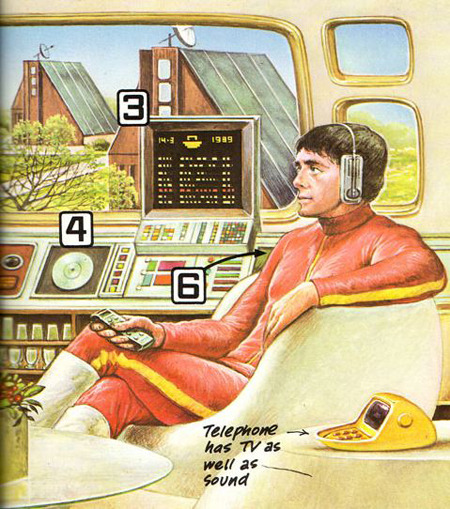
As a kid of about 8 years I used to spend my afternoons during the long school holidays going to the local library. There I would sit down and read books (my favorite was the Usborne Book of the Future) on how life would be in the future. Usually this was amazing things that were promised to occur around the year 2000. I would pour over the pages of people living in space and will time to speed up so that I could begin living the wonderful promised life. And then 2000 happened and well not much. No space communities. No flying cars.

So instead of willing time to speed up, I’m taking a different tact. I’m working on building the future.

I’ve been so busy the last few months working on some really cool technology with a really cool team. I believe that what we are building will really change how we communicate with each other and be free of any single company controlling the technology (similar to how email works – you have a choice of providers).

Federated buddycloud channels are a way that anyone can run their own social network and all the social network nodes interconnect and pass information to eachother.The idea with buddycloud channels being federated is to keep the architecture and protocol as simple as possible by glueing together best-of-breed existing protocols into a recipe and developing client and server implementations that show off how this works.

The development team is growing, everyone donating time and effort to the project and it’s great to see the level of enthusiasm behind this. Thanks.

If you would like to play a role in building some disruptive technology, head over to the federated social networking development pages.

… and welcome to the future.

Should anone ask, treat life as an expriment

Three great tastes come together in this video: Stanford lectures (awesome people talking about awesome things) and IDEO (awesome design) and personal development (becoming even more awesome) come together in this video.

Here is Tom Kelley, General Manager at IDEO

http://ecorner.stanford.edu/swf/player-ec.swf

What does concern me through is that sometimes we need to dig in to get beyond the “experiment with everything” phase of our lives. Not everything will be the enjoyable experiment. That said, I have noticed that I work much better on things that I enjoy.  Much! Thoughts?

Should anyone ask, the “thunder box” has been upgraded.

Dear Cats, Fear ye not the rushing of air as thou relieviest oneself. Allow me to introduce your new and vastly improved ventilation system for the thunderbox.

In the summer I usually keep the cat toilet on my terrace and leave the door open. With Autumn approaching leaving a door open is not going to be easy. Then the cat toilet migrates to the bathroom where it usually smells no matter how often I empty it. The bathroom in my apartment has an extractor fan that runs continuously to create a slight negative pressure. By using this, a hose and a coupling I have extended it the cats toilet thus:

It means a bit of a jump up but the jump is lower than the jump to get their food so if they can jump for the INPUT cycle, an OUTPUT jump shouldn’t be too bad.

An overall view.

Dear visitors, it’s now possible to visit again sans fumigation.

Should anyone ask, housekeeping is underway

I want to be able to go away and not to worry about servers breaking or being out of reach. So I have been taking the first steps to get rid of all the bits that I try to self-host.  First and easiest is the blog. This blog is now on Posterous. Second will be email. I’m planning on moving all imaginator.com email to gmail. Don’t worry, it’ll be mostly seamless. You will still log in at mail.imaginator.com to read it. Just with a much better interface. Unless you tell me otherwise, all your old mail will be migrated over.

I’ll post an announcement nearer the time of the mail migration. This way if a server does go bump in the night, an engineer in Mountain View is paged and not me in Munich or half way up a mountain.

Hope everyone has had a nice summer. Best regards,

Your maintenance crew.

Should anyone ask, life is a series of conversations, and you die.

Found on my desktop:

  • Life is a series of conversations.  You are not living it unless you are having those conversations.  Step up and talk.

Steve Jobs: Your last day of life:

  • Live every day as the last:Remembering that I’ll be dead soon is the most important tool I’ve ever encountered to help me make the big choices in life. Because almost everything — all external expectations, all pride, all fear of embarrassment or failure – these things just fall away in the face of death, leaving only what is truly important. Remembering that you are going to die is the best way I know to avoid the trap of thinking you have something to lose. You are already naked. There is no reason not to follow your heart. – Jobs.

And from Tom Perkins:

  • Think for yourself.
  • Always go back to basics

Should anyone ask, some thoughts on application development

In 1984, Bob Scheifler and Jim Gettys set out the early principles of X:

  • Do not add new functionality unless an implementor cannot complete a real application without it.
  • It is as important to decide what a system is not as to decide what it is. Do not serve all the world’s needs; rather, make the system extensible so that additional needs can be met in an upwardly compatible fashion.
  • The only thing worse than generalizing from one example is generalizing from no examples at all.
  • If a problem is not completely understood, it is probably best to provide no solution at all.
  • If you can get 90 percent of the desired effect for 10 percent of the work, use the simpler solution. (See also Worse is better.
  • Isolate complexity as much as possible.
  • Provide mechanism rather than policy. In particular, place user interface policy in the clients’ hands.

The first principle was modified during the design of X11 to: “Do not add new functionality unless you know of some real application that will require it.”

X has largely kept to these principles since. The reference implementation is developed with a view to extension and improvement of the implementation, whilst remaining almost entirely compatible with the original 1987 protocol.