Sould anyone ask, there’s nothing like directory enquiries.

My day started out with me calling to wish a friend happy birthday.  Except that it wasn’t and only takes place on Saturday.  Instead we ranted for 30 minutes about how bad the mobile phone carriers are, the problems of having to work with them and so on.  We even had a go at various directory enquiry services and how difficult it is to determine the costs of calling each one.  I shouldn’t have been so hasty in my criticism of them.After 8 years of loosing contact with a good friend, I spent some time googling her.  I’d lost her contact details but remembered which borough of London she lived in. It felt weird to be searching on someone after all this time. She does PR and her name was on a couple of press releases but no longer worked at the companies involved.  I could have tracked her down in 2 minutes had I realised that some people still list their phone numbers.

My heavily criticised directory enquiry site revealed her number and her address in no time, and I’m looking forward to having coffee with an old friend next time I am in London.Sometimes old school technology is best.

Should anyone ask, I prefer my traffic to be “shaped”

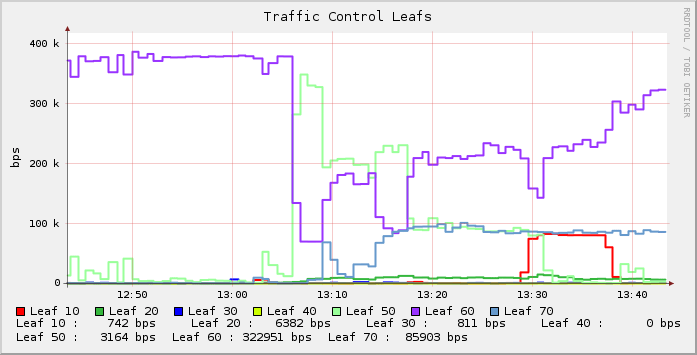
I’m having much success with my traffic shaping rules. I prioritise my outbound traffic and graph it. Traffic is currently sorted into the following classes:

  • Leaf 10: VOIP
  • Leaf 20: ACKs, ICMP
  • Leaf 30: DNS, SSH (not scp)
  • Leaf 40: Streaming audio
  • Leaf 50: Web, SMTP, IMAP
  • Leaf 60: SCP
  • Leaf 70: Bulk, P2P, unclassified packets

This works out well:

Here the red line show’s an outbound voip call, an ongoing rsync via ssh (purple) and some random person accessing website in light green. The light blue shows a bittorrent download.

Each of these classes is subordinate to the other although each can only max out to 90% of the link before having to start sharing the link with subordinate classes.

Even if I had a T1/E1 entering my house, I’d still shape it. Shaping really enhances the responsiveness when using a congested link.

My shaping rules are downloadable and graphed. I also graph general traffic.

Should anyone ask, I prefer my traffic to be “shaped”

I’m having much success with my traffic shaping rules. I prioritise my outbound traffic and graph it. Traffic is currently sorted into the following classes:

  • Leaf 10: VOIP
  • Leaf 20: ACKs, ICMP
  • Leaf 30: DNS, SSH (not scp)
  • Leaf 40: Streaming audio
  • Leaf 50: Web, SMTP, IMAP
  • Leaf 60: SCP
  • Leaf 70: Bulk, P2P, unclassified packets

This works out well:

Here the red line show’s an outbound voip call, an ongoing rsync via ssh (purple) and some random person accessing website in light green. The light blue shows a bittorrent download.

Each of these classes is subordinate to the other although each can only max out to 90% of the link before having to start sharing the link with subordinate classes.

Even if I had a T1/E1 entering my house, I’d still shape it. Shaping really enhances the responsiveness when using a congested link.

My shaping rules are downloadable and graphed. I also graph general traffic.

Should anyone ask, bunker filters lots of spam

Spammers are turning to image spam to avoid filters.  The introduction of grey-listing has dramatically reduced imaginator.com spam but in the end spam protection is a never ending arms race – until someone comes up with a new way to do email.  And that ain’t happening any time soon.I’ve been graphing bunker’s mail statistics. The mail server is rejecting up to 40 messages a minute, and that’s before they even hit the spam filter, the virus filter, a content filter and finally get accepted for delivery.  So the odd one that gets through has had to pass lots of tests. Consider it special…